
“Even I Get Goosebumps During the Show”: Inside the World of Live Lighting with sakanaction’s Yusuke Honda | MUSIC AWARDS JAPAN 2026 Winner Interview
Launched in 2025 under the concept “Connecting with the world, illuminating the future of music,” MUSIC AWARDS JAPAN (MAJ) is Japan’s largest international music awards. MAJ 2026 expanded to 78 categories, including newly established awards recognizing the professionals working behind the scenes of concerts and live events.
OTOMO spoke with Yusuke Honda of Akari Center, who received the Best Lighting Production Staff award for his work on sakanaction’s “SAKANAQUARIUM 2025 ‘Kaiju’” tour. From the creative process behind sakanaction’s live productions to the challenges and rewards of working in concert lighting, Honda shares his insights into the craft of lighting design and reflects on what the award means to him.
Interview by Kyu Nakanishi
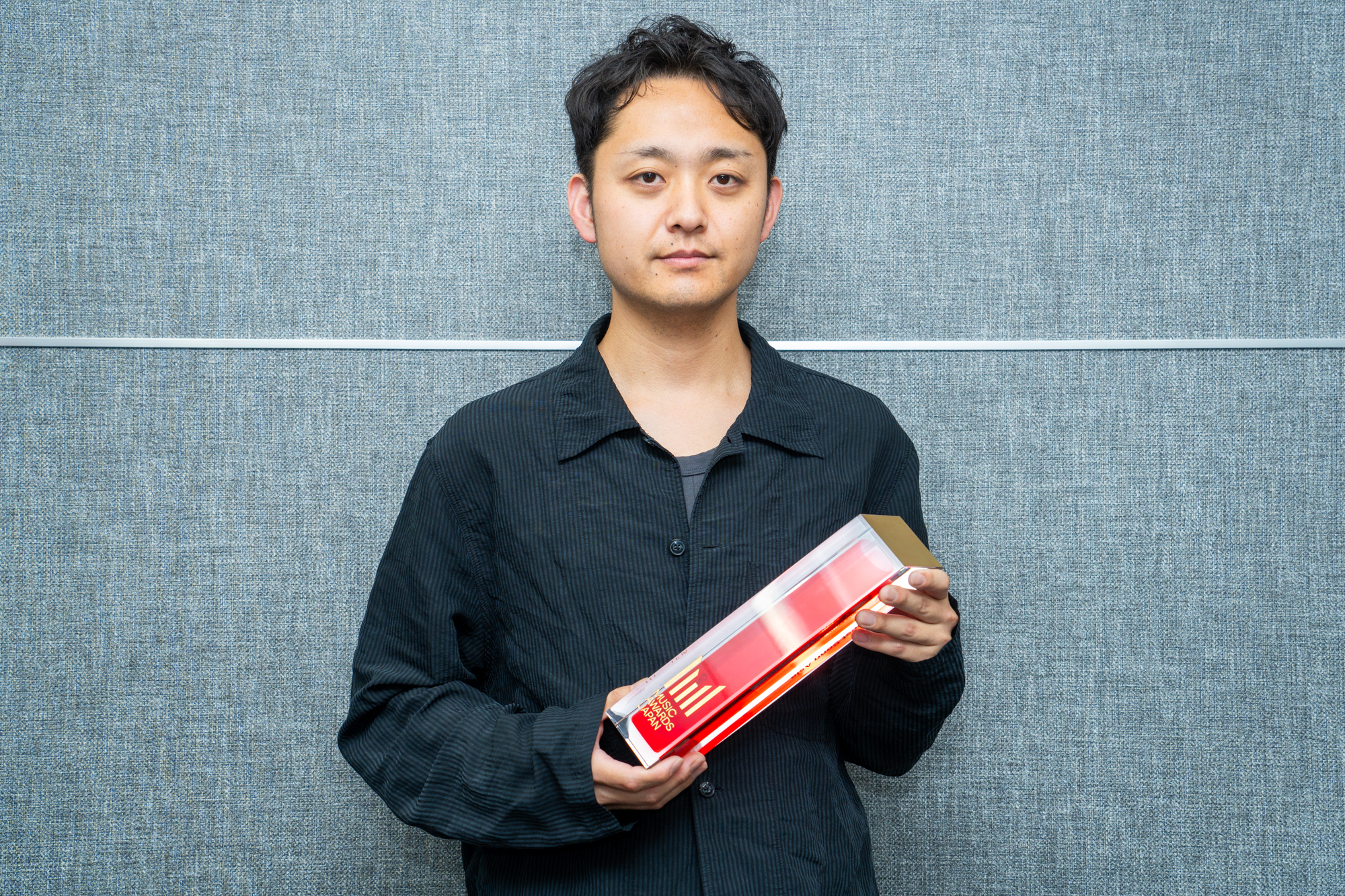
The Thought Behind Every Lighting Decision
–You handle lighting design, operation, and installation supervision. Could you tell us a little about what each of those involves?
Sure. Lighting design is about deciding which lights to use, where to place them and how they'll be used for each song, based on the concept of the show and the band's style.
Then there's lighting operation, which involves programming the lighting and controlling it during the show. Sometimes the designer handles the programming too.
And installation supervision is basically overseeing the crew from setup through to teardown, making sure everything is installed according to the design.
—So those are the three main parts of the job?
That's right. For sakanaction's “SAKANAQUARIUM 2025 ‘Kaiju’” tour, I handled all three.
—Is it common for one person to do all of that?
For bigger shows in arenas or stadiums, the roles are often split up. You might have someone in charge of setup and teardown, while different people handle the design, programming and operation. But for smaller shows in concert halls, it's not unusual for one person to do several of those jobs.
The final show of this tour was in an arena, but the rest were in concert halls, so we toured with a crew suited to that scale.
—Lighting design is about translating the artist's or director's vision into the lighting setup. How does that process work?
With sakanaction, Yusuke Tanaka oversees the overall creative direction of the show. He works closely with the band from the very beginning, including putting together the setlist.
He'll give us an idea of the atmosphere and world he wants to create, and we'll work together on the lighting setup. He knows every song inside out, and he and the band put a lot of thought into the order of the songs and the story they want to tell. I think that's what makes sakanaction's live productions so special. There's a real depth to everything they do.
—So even the smallest lighting details have a specific purpose?
Take the opening of “Kaiju,” for example. It starts with a spotlight on the vocalist, and if it's even slightly off, the whole effect is lost. It completely changes what that moment is supposed to convey.
And rather than lighting up his whole body, the light cuts across him at an angle. Even moving it 10 or 20 centimeters can completely change how his face looks, so you really can't afford to get it wrong. It was nerve-racking every single time [laughs].
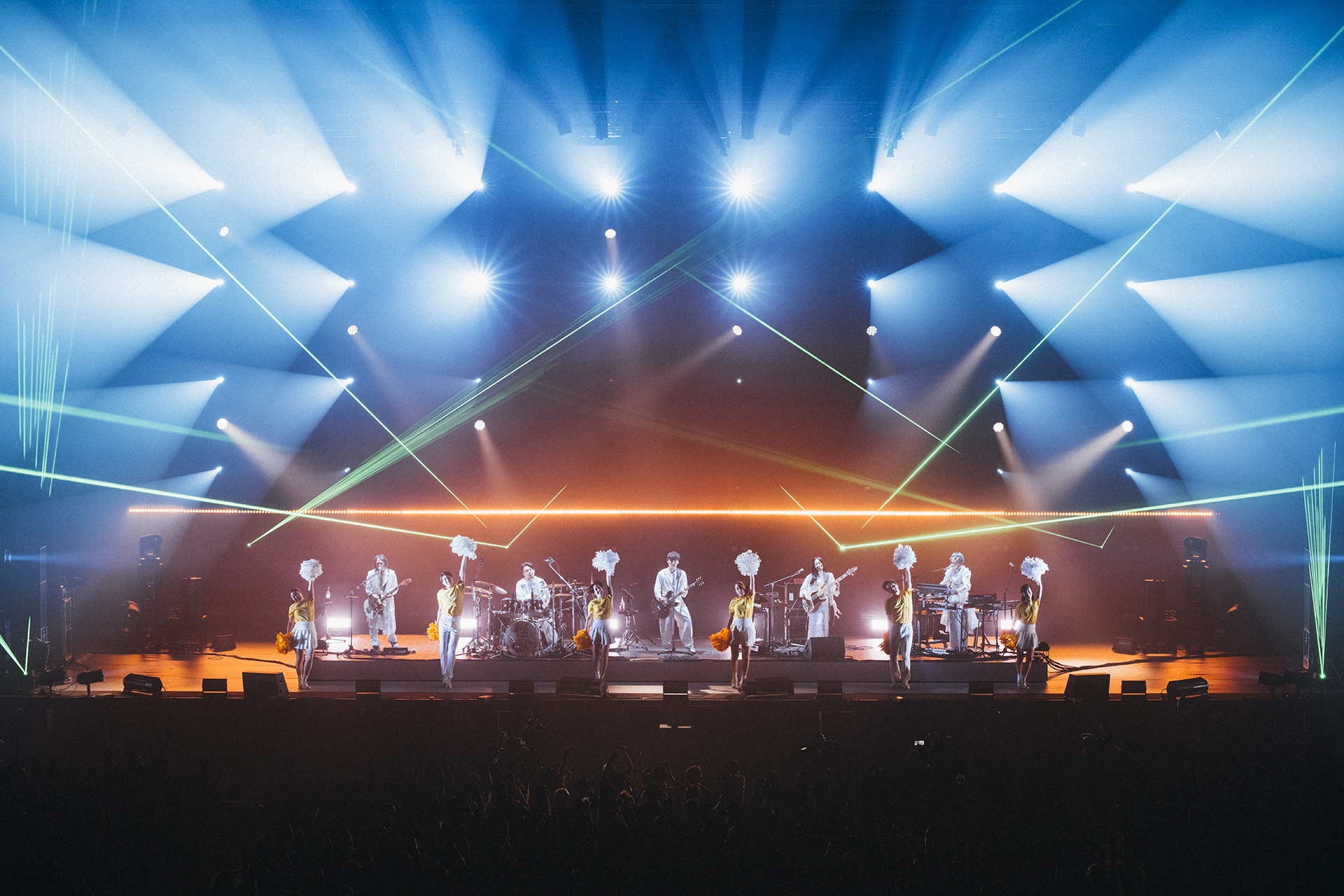
A scene from Sakanaction's tour 'SAKANAQUARIUM 2025(Photo by Takehiro Goto)
A United Front Behind sakanaction’s Live Shows
—Communication with the artists and creative director must be important when it comes to understanding their vision. What do you keep in mind when working with them?
If there's something I don't understand, I just ask.
—That's a great approach.
I don't like moving forward when there's something I'm not quite sure about, so I always ask, even if it's something small. Those little things can turn into bigger problems later on, so I'd rather risk looking stupid than leave anything unclear.
And with sakanaction, nobody minds me asking questions. It's almost second nature now. “What's the plan for this again?” without even thinking about it.
—Is it always that easy to ask questions, or does it depend on who you're working with?
Definitely. Some artists prefer to leave everything about the production to the team so they can focus entirely on performing. Once they arrive at the venue, they deliberately try not to think about anything other than the music. In those cases, we just have to read the room and work around that.
—Working closely with other departments must be important too, whether it's sound, stage design or, especially these days, video production.
Absolutely. With sakanaction, Tanaka is also involved in creating the visuals, so we can work together on everything from scratch. That makes things a lot easier.
And on the sound side, Sachio Sasaki, who also won the Best Sound Production Staff award this year, has built a strong relationship with the band. So there's rarely anything we need to step in and raise concerns about. We communicate well, of course, but often there's simply no need to go back and forth about things.
—It sounds like everyone working on sakanaction's shows is really on the same page.
Exactly. Tanaka lays the groundwork for everything, which allows the whole team to work together toward the same vision.
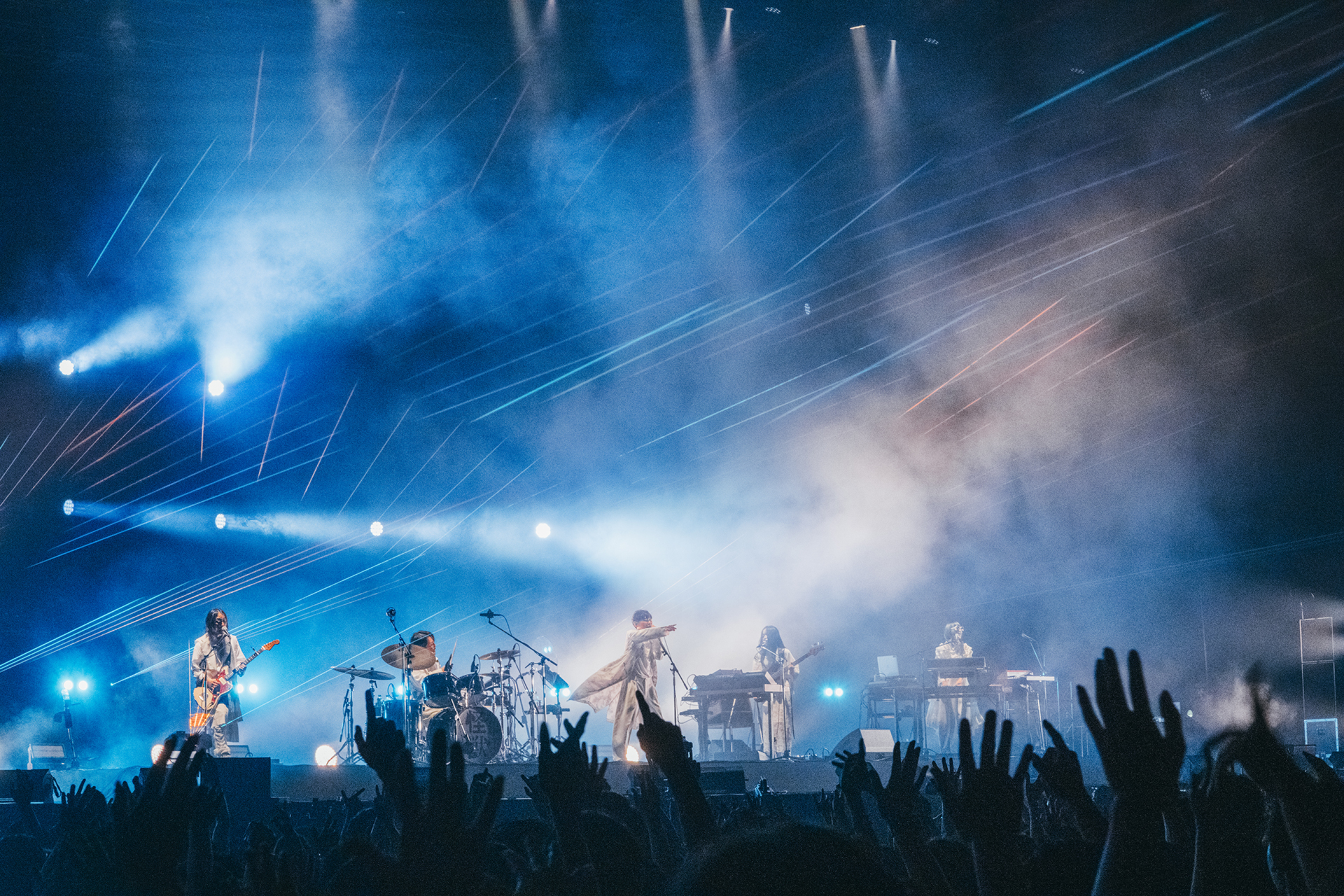
A scene from Sakanaction's tour 'SAKANAQUARIUM 2025(Photo by Takehiro Goto)
—What about other productions? I'd imagine lighting and video don't always see eye to eye. Do things ever go wrong?
All the time.
—Really, all the time? [laughs]
LED screens these days are far brighter than the projectors we used to use. Just switching one on can light up the whole stage. It almost makes you wonder what we're there for [laughs].
When there's a lot of white in the visuals, especially, our lighting beams can disappear completely. Sometimes a director will ask for colorful beams to liven things up, and we have to explain that with those visuals on screen, you won't be able to see them anyway.
It's also becoming pretty common to have the entire back of the stage covered in LED screens. So you really have to think about how the visuals and lighting will work together when creating the video content. Thankfully, I've been seeing more productions take that into consideration lately.
—So people have learned how to make the most of both as technology has evolved.
Exactly. It used to be the other way around. Our lights would wash out the projected images, and we'd have to dim them just so you could see what was on screen. We've learned from those experiences, and things have gotten a lot better.
Of course, it also comes down to what the artist wants to emphasize. With an idol group, for example, being able to see the members' faces is obviously important, so live camera footage might take priority.
It's about making sure everyone understands what matters most and working together to find the best approach. So I guess this isn't really a job for someone who's socially awkward... or rather, someone who struggles with communication.
Beyond the Spotlight: A Win for the Whole Team
—As you mentioned earlier, sakanaction's “SAKANAQUARIUM 2025 ‘Kaiju’” tour, which you worked on as lighting designer, won the Best Lighting Production Staff award at MUSIC AWARDS JAPAN 2026. How did you feel when you heard the news?
When I first heard about the nomination, I honestly didn't think I'd win. All the other nominees were more senior than me, and they'd worked on arena and stadium shows, while I'd been working on a concert hall tour.
Of course, that doesn't mean lighting for concert halls is any less sophisticated than lighting for arenas. But looking at the other nominees, I couldn't help thinking, “Me, ahead of all these incredible people?”
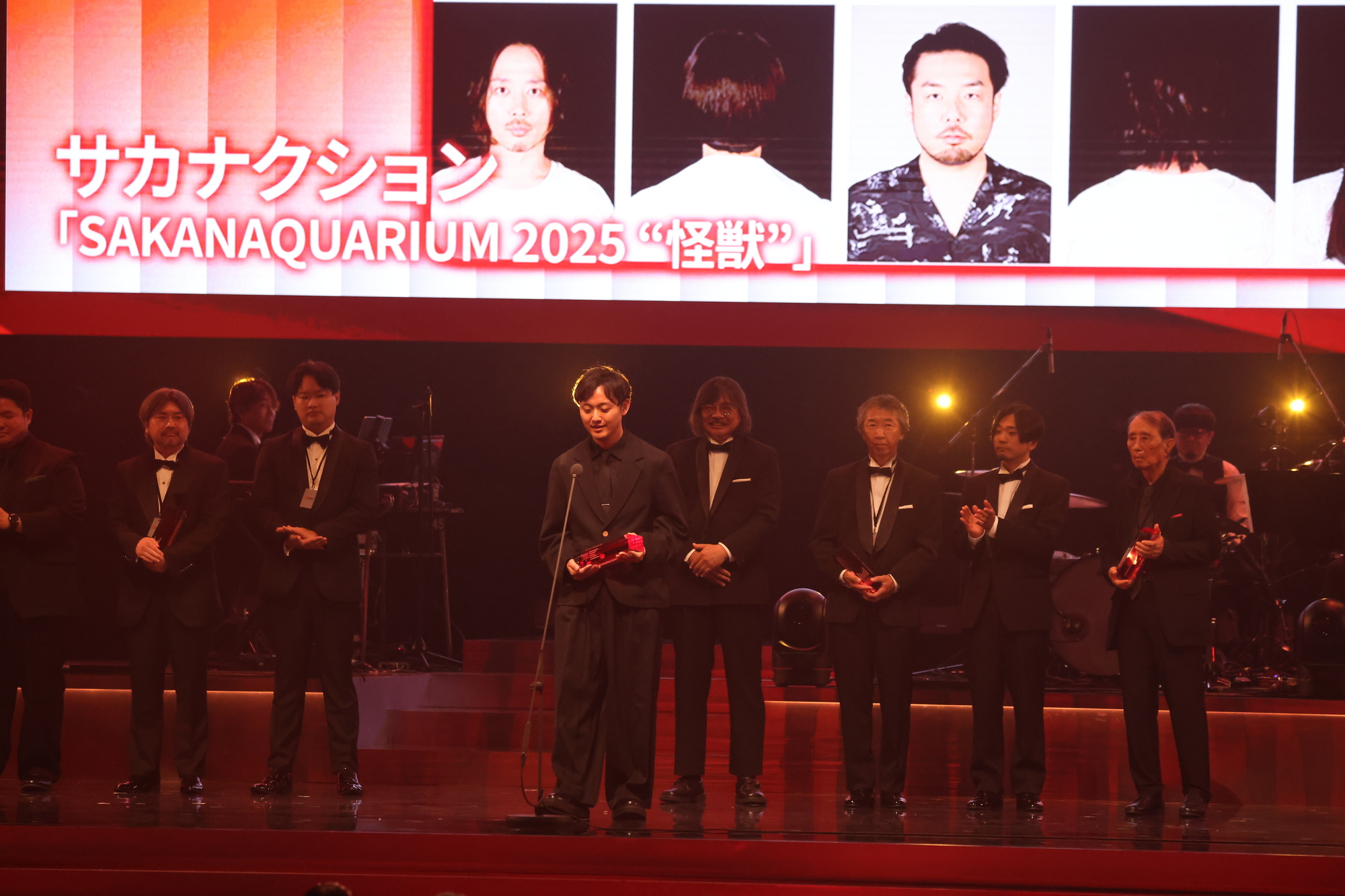
Yusuke Honda taking the stage at the 'MUSIC AWARDS JAPAN 2026' Premiere Ceremony.
—What do you think made your work stand out to the judges?
I don't think it was the lighting alone that was recognized. What the judges appreciated was something we'd all created together — the band, the creative director and everyone working across the different departments.
I just happened to be part of that. I don't really see it as recognition of my individual work. To me, it's an award the whole team won together.
—As a professional, what makes a lighting design stand out to you?
I'd say there are two main things. The first is when I see a lighting setup I would never have thought of myself. Sometimes I'll see a fixture placed somewhere completely unexpected and think, “You put that there?” That kind of creativity really impresses me.
The other is how the lights are used during the show. Even if there's nothing unusual about the equipment or where it's positioned, someone might use it in a way I've never seen before, and I'll think, “That's brilliant!” Of course, it's not just about doing something different for the sake of it. It's when that unexpected approach actually works as part of the show that I think, “I never would have thought of that!”
—Doing something nobody's done before is one thing, but making it work is another. That takes real ingenuity.
Exactly. With most lighting equipment, there's a general understanding of what it's meant to be used for. So when someone uses it in a completely unexpected way, it really surprises me. I think, “You can use it like that?” And of course, trying something nobody's done before means taking a risk. It might not work.
—Do you ever experiment with unconventional ways of using lighting equipment yourself?
I actually started out working in lighting for film and video shoots, rather than live shows. So I often end up bringing equipment meant for filming into concerts, or taking concert lighting equipment onto other kinds of sets.
The crew setting up the lights will sometimes be surprised by how I use the equipment.
For example, I sometimes hang large, flat light panels facing straight down. Normally, the crew will automatically point them toward the audience, because that's how they're usually installed. But when I tell them I want the lights pointing straight down, they'll wonder what the point of that is [laughs].
That sort of thing happens quite a lot.
—What kind of effect does that create?
I use them to provide a bit of general lighting for the performers. They create a distinctive quality of light that you can't really get with other fixtures.
I also often use HMI lamps, which are powerful lights commonly used in film production, and position them at the sides of the stage. People tell me that's not how you're supposed to use them, though.
—So you're always looking for new possibilities rather than just sticking to the usual methods.
Actually, none of this year's nominees, myself included, are what you'd call traditional lighting designers. We all tend to do things a little differently. Before the awards, we were joking that whoever won, it wouldn't exactly be a conventional choice [laughs].
I suppose I might have been doing the strangest things of all. There were even three songs in sakanaction's show where we used nothing but three light bulbs.
—In a way, it sounds like the lighting industry is increasingly embracing unconventional ideas. And sakanaction is a band known for pushing boundaries, so perhaps the two were a natural fit.
I think so. Our approaches definitely aligned in that sense.
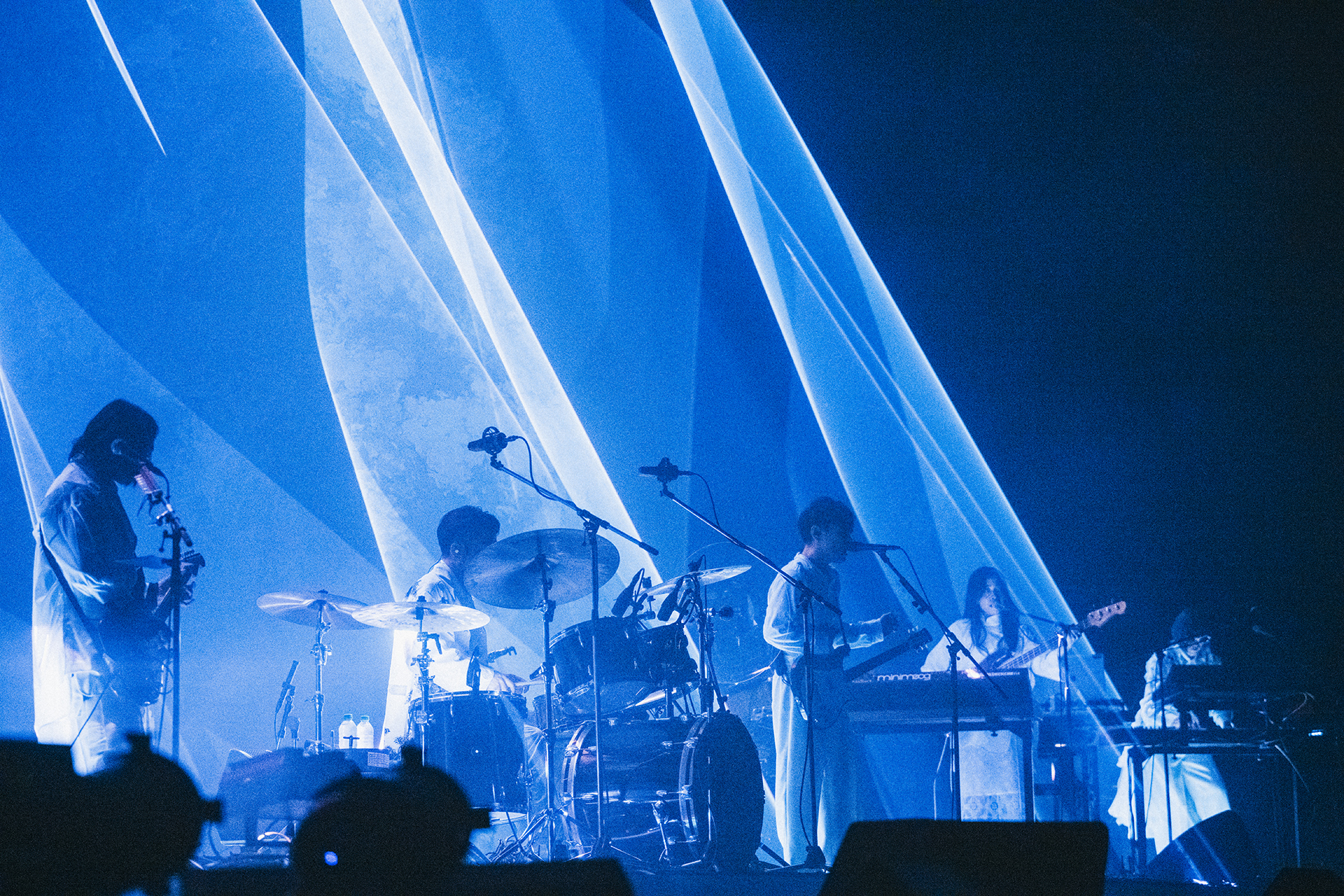
A scene from Sakanaction's tour 'SAKANAQUARIUM 2025(Photo by Takehiro Goto)
The Most Rewarding Part of the Job
—What's the most rewarding part of your job?
The actual performance, without a doubt. We spend so much time preparing, and I've already seen the same lighting countless times during the creative process and rehearsals. But somehow, when it's the real show, everything feels different.
I think it's because the artists put their emotions into the music, and then you have the energy of the audience cheering them on. When all of that comes together with the lighting, I get goosebumps watching it, even though I'm the one who created it. Those are the moments that make me feel like all the hard work was worth it.
—That's wonderful!
I think a big part of it is that lighting is something you can actually see. I'm no expert when it comes to sound, so I imagine it's pretty difficult to judge whether something sounds good or bad. There's also a lot of personal taste involved.
Lighting, on the other hand, is relatively easy to understand. If a spotlight misses the performer, for example, even someone with no technical knowledge can tell something's wrong.
Being able to point to something like that and say, “I made that,” might be the most satisfying part of the job.
—And what's the most challenging part?
The deadlines. Artists are always trying to make their shows better, right up until the last minute. So it's pretty common for someone to suggest changing how a particular moment looks, even just before the show.
When that happens, we all have to work together to make the necessary adjustments. If it only involved my own work, it wouldn't be so difficult, but there are other departments to consider too. Making sure everyone stays on the same page and nothing goes seriously wrong can be quite a challenge.
—What kind of person do you think is suited to this line of work?
Someone whose passion outweighs the difficulties, I'd say. There are plenty of tough moments, and without something that really drives you, it's hard to keep going.
It doesn't matter whether you love live music, lighting equipment or just tinkering with machines. I think as long as there's something you're genuinely passionate about, you've got what it takes to do this job.
—And what is it that you love most about the job?
I've always loved light itself. I remember seeing sunlight streaming through a break in the clouds when I was little and thinking how beautiful it was. That was where it all started.
That fascination eventually made me want to pursue a career working with light, and that's how I ended up here.
At first, it was really just my interest in light itself that drove me. But these days, I think what motivates me most is the sense of achievement I get when I look at a concert or a video production I've worked on and feel that we've created something really good.
A Little Recognition Goes a Long Way
—With technology advancing so quickly, where do you see the lighting industry heading?
In countries like the US and South Korea, timecodes have become pretty standard. It allows lighting to be synchronized with music and video, so a lot of the lighting during shows is now controlled automatically.
More recently, AI has even started handling lighting design. And to be honest, the results aren't bad at all.
—So the industry is moving toward less and less human involvement.
But that technology hasn't caught on to the same extent in Japan, and there's a reason for that. There's still a strong emphasis on the live, spontaneous nature of performances here.
Whether it's a band playing live or a theater production, you have to respond to the performers in the moment and work in sync with them. That's something you can't always leave to automation.
Some people are already combining the two approaches, using automated controls for the basic lighting cues while making manual adjustments at key moments.
I think if we can bring technology and human craftsmanship together in that way, taking the best of both, we'll be able to create even more incredible shows.
—Now that MAJ has introduced an award recognizing lighting professionals, perhaps more people will be inspired to pursue a career in the industry. Is that something you hope to see?
I wouldn't go so far as to say I want to lead the industry, but I do hope that opportunities like this interview can help inspire the next generation.
Take dance, for example. Young dancers see the top performers and think, “I want to be like them someday.” That's how the scene keeps growing and new generations come through. It's the same with baseball players.
So if someone like me, who's been given a chance to be in the spotlight, can show people what's great about this job, I'd be really happy.
—So you could become the Shohei Ohtani of the lighting world...
I wouldn't go that far [laughs]. For now, I just want to keep my feet on the ground and focus on doing my job well. And if that ends up having a positive influence on someone along the way, that would be great.
The thing is, we don't actually get praised very often in this job. After a show, it's rare for the first thing you hear to be how amazing it was. Usually, people start by pointing out what went wrong.
—So people just expect everything to be perfect?
Exactly. That's why I often feel like saying, “Can we get a little praise first?” [laughs]
There are so many times when I wonder why we get so little recognition despite all the hard work we put in. So I'm really grateful that awards like MAJ give people in our profession a chance to be recognized for what they do.